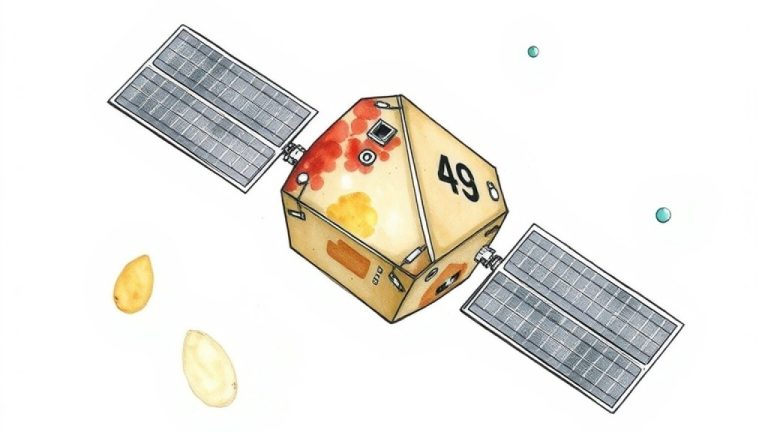
NASA's Voyager 1 became the first human-made object to sit one light-day from Earth on Wednesday, 18 November, nearly half a century after it left the launch pad in 1977. The probe passed the mark at 5:16 a.m. Eastern time, according to reports of the agency's figures, and at that range a radio command moving at the speed of light needs a full 24 hours to arrive. NASA described the distance, in its own words, as "very, very far."
A day for every message
A light-day is the span that light covers in 24 hours, and the probe's position now turns that definition into a practical delay for the people who fly it. A message sent from the ground takes about a day to reach the spacecraft, and any reply needs roughly another day to come back, so a single exchange of commands and confirmation stretches across two days.
Kim Heacox, an author writing in an opinion column for the Guardian, said the returning signals are so weak that scientists at NASA's Deep Space Network depend on a massive satellite dish to pick them up. He gave the speed of those radio signals as 186,000 miles per second, and described the probe as a robotic craft roughly the size of a Mini Cooper.
The probe had already held the title of most distant human-made object before it crossed the new threshold, and no spacecraft has travelled farther. By the journal's count, the probe has been travelling outward from Earth for more than 49 years.
Measuring the distance
The reports describe the same distance in slightly different units and degrees of rounding. One account, written after the crossing, gave the probe's distance from Earth as 16.094 billion miles, while the scientific journal Nature gave the figure as 25.9 billion kilometres. Other reports, citing NASA, rounded it to about 26 billion kilometres, or 16 billion miles, and Heacox wrote 16.1 billion miles.
Nature recorded the crossing at 5.16 a.m. EST on 18 November, matching the Wednesday morning time given elsewhere. The journal's article carries a date of 17 November, one day earlier than the crossing time it reports.
The probe's speed is also given in rounded terms. One report said it was moving at nearly 38,000 miles per hour, and Heacox put the figure at 37,800 miles per hour.
Tiffany Kataria, a NASA scientist, told AFP that the achievement was "the best illustration of just how vast space is." She set the distance against the ambitions of space exploration. "So much of what we dream about is traveling to other stellar systems," Kataria said.
She went on: "And it took Voyager 1 nearly 50 years to get to just the edge of our own solar system, let alone to only a light-day." Kataria also pointed out that many systems of planets around other stars lie at least several light-years from Earth.
Two probes on a long road to the stars
Deana Weibel, an anthropologist at Grand Valley State University in Allendale, Michigan, who studies space exploration, told Nature that the journey had already outlasted much of a human life. "It has taken longer than half of a typical human lifespan to reach that distance — so on that level it’s amazing," she said.
Weibel also noted that Voyager 1 has covered only a small part of the way to Proxima Centauri, the star closest to the Solar System. That star lies 4.2 light years away, which the journal converted to almost 1.3 parsecs, or more than 1,500 light days.
Two accounts describe the probe's onward course. One said Voyager 1 has been travelling towards a star called Gliese 445, in the Ursa Minor constellation, since it finished its main planetary work in 1980; that star is 17 light-years away, and the report said the probe would not pass it for around 40,000 years. Heacox wrote that the spacecraft is bound towards the constellation Ophiuchus rather than Proxima Centauri.
NASA expects the probe to need about 18,000 years to cover a full light-year, according to one report, while Heacox put the time at roughly 17,600 years, so the two estimates differ.
Voyager 1 and its twin, Voyager 2, were launched in 1977 to explore the outer Solar System. Voyager 2 actually left Earth 16 days before its sibling, according to one report, and Heacox wrote that Voyager 1 was launched in early September 1977.
The two craft remain the only spacecraft known to have reached interstellar space, the region beyond the heliosphere, which Nature described as the zone in which the Sun shields Earth and other bodies from the influence of deep space.
Voyager 1 moves faster than Voyager 2 and left the heliosphere in 2012, crossing a boundary called the heliopause; its twin followed six years later. Voyager 2 is expected to reach the one light-day mark in 2035.
Science from between the stars
Both probes are still returning data, and the observations they send are the only direct measurements of interstellar space ever made, according to the journal. Another report said Voyager 1 continues to send back readings on plasma waves, magnetic fields and particles in space, even though radio signals now take a whole day to cross the gap in each direction.
Kataria said the probe is still studying phenomena that cannot be seen, such as magnetic fields. The information allows researchers like her to examine "the gas, the dust and other material that exists between stars, between our sun and other stars."
Some of the most notable recent findings concern the Sun's reach. The Voyagers found that bursts of solar material sometimes push right through the heliosphere and set off shockwaves in the normally calm interstellar region, effects the probes detect as shifts in magnetic fields, energetic particles and other conditions.
From around 2020, for example, an approaching pressure front drove the magnetic fields around the two probes sharply higher before they fell again six years later. Researchers are still trying to work out the cause, the journal reported.
Jamie Rankin, a space physicist at Princeton University in New Jersey and the deputy project scientist for the Voyagers, said the reach of these solar effects had been a surprise. "I think people didn’t quite anticipate how far out these influences could be felt," Rankin said.
Rankin added that the finding suggests stars other than the Sun may also be shaping the interstellar medium more strongly than scientists had assumed, "so that’s where it gets fun".
Discoveries from the planetary tour
Before they left the planets behind, the Voyagers flew past Jupiter, Saturn, Uranus and Neptune between 1979 and 1989, in a tour that the journal said transformed scientific knowledge of the Solar System. Voyager 1 itself conducted flybys of Jupiter and Saturn and, according to one account, completed those primary objectives in 1980.
Among the findings the journal highlighted were volcanoes on Io, a moon of Jupiter, which were the first volcanic activity found anywhere beyond Earth. The probes also revealed an icy, cracked crust on the moon Europa, which is now thought to cover an ocean that might be able to support life.
Kataria said that images of Jupiter taken by Voyager 1 were the first to show that the gas giant has rings. Those pictures also helped scientists make sense of the "really extreme vortices and weather that take place in the atmosphere," she said.
"You could find so many things that both of these spacecraft have really enabled in our understanding," Kataria said of the pair.
Running down the power supply
The probes' longevity has limits. Both run on plutonium power that is steadily declining, and mission controllers have been switching off scientific instruments to save as much energy as they can, the journal reported. Cameras are among the equipment on Voyager 1 that has been turned off remotely for this reason.
According to the journal, Voyager 1 is expected to lose contact with Earth in 2029, when its power finally runs out, and Voyager 2 is expected to do so in 2031. Heacox gave a looser estimate, writing that Voyager 1 will probably fall silent sometime in the 2030s, and added in his column that the probe would then keep travelling onward, carried by inertia.
Conditions in interstellar space are harsh. The journal reported that the two probes are now exposed to frigid temperatures approaching minus 80 degrees Celsius.
A message carried beyond the Sun
Each Voyager carries a "Golden Record", a gold-plated copper disc 30 centimetres, or 12 inches, across, meant to tell the story of life on Earth to any extraterrestrials that might find it.
In his column, Heacox described the contents of the disc: photographs, greetings in 55 human languages, music by Mozart and Chuck Berry, and the sounds of a crying baby and a singing whale. He wrote that it also carries a time stamp and a map that locates the Solar System relative to 14 pulsars, which he described as dense remnants of massive stars. The astronomer Carl Sagan chaired the committee that designed it, according to the column.
Heacox recounted that in the late 1980s Sagan pressed NASA to point the probe's cameras back towards Earth, and that the agency hesitated because it feared the instruments could be damaged. The cameras were finally turned on Valentine's Day 1990, and the resulting image showed Earth as a fraction of a pixel. Sagan named the picture the "pale blue dot", the column said, and likened the tiny Earth in it to "a mote of dust caught in a sunbeam".
The column also quoted Sagan's written reflection on the image. "It has been said that astronomy is a humbling and character-building experience," Sagan wrote, according to Heacox, who presented the photograph as a reminder of how small and shared the planet is.
Heacox used the milestone to argue that humans have badly damaged the planet since the probe's launch, citing scientists who say people have "gravely altered" the chemistry, biology and physical structure of Earth's land and water. He wrote that the challenge could still be eased if people learn to live together.
This report was prepared with AI assistance and checked against the sources it relied on. Read our editorial standards and methodology.
Corrections
If you believe this article contains an error, please contact the newsroom with the details and supporting evidence.